


Best Medical Software of 2026
Updated March 20, 2026 at 12:56 PM
- Popular Comparisons
- Buyers Guide
Compare Products
Showing 1 - 25 of 425 products
Compare Products
Sort by
Reviews: Sorts listings by the number of user reviews we have published, greatest to least.
Average Rating: Sorts listings by overall star rating based on user reviews, highest to lowest.
Alphabetically (A-Z): Sorts listings by product name from A to Z.

The AdvancedMD EHR Software offers a comprehensive Electronic Medical Record (EMR) service designed to streamline and optimize v...Read more about AdvancedMD EHR
AdvancedMD EHR's Best Rated Features
See All
AdvancedMD EHR's Worst Rated Features
See All

CharmHealth is a comprehensive suite of healthcare solutions designed to streamline practice management, revenue cycle managemen...Read more about CharmHealth


CharmHealth's Best Rated Features
See All
CharmHealth's Worst Rated Features
See All

RXNT’s cloud-based, ONC-certified medical software—Billing, Practice Management, EHR, and more—improves clinical outcomes & reve...Read more about RXNT


RXNT's Best Rated Features
See All
RXNT's Worst Rated Features
See All

athenaOne is an integrated solution designed for healthcare practices, offering electronic health records, revenue cycle managem...Read more about athenaOne


athenaOne's Best Rated Features
See All
athenaOne's Worst Rated Features
See All

Tebra helps independent medical practices plug the revenue leaks caused by no-shows, manual processes, and slow reimbursements. ...Read more about Tebra


Tebra's Best Rated Features
See All
Tebra's Worst Rated Features
See All

AestheticsPro is an all-in-one, cloud-based software platform built exclusively for medical spas, wellness centers, and aestheti...Read more about AestheticsPro


AestheticsPro's Best Rated Features
See All
AestheticsPro's Worst Rated Features
See All

Elation Health is the most trusted technology platform for high-value primary care. Since 2010, the company has delivered clinic...Read more about Elation


Elation's Best Rated Features
See All
Elation's Worst Rated Features
See All

PatientNow is an EMR practice management software designed for aesthetic and wellness providers. It supports various specialties...Read more about PatientNow


PatientNow's Best Rated Features
See All
PatientNow's Worst Rated Features
See All

Nextech is redefining what’s possible in specialty healthcare. As an award-winning technology partner for specialty practices an...Read more about Nextech EHR & PM

Nextech EHR & PM's Best Rated Features
See All
Nextech EHR & PM's Worst Rated Features
See All

NextGen® Office is an all-in-one, cloud-based support system designed to help independent practices improve clinical outcomes, i...Read more about NextGen Office


NextGen Office's Best Rated Features
See All
NextGen Office's Worst Rated Features
See All

ReLi Med Solutions' suite gives small to midsize ambulatory care practices a completely integrated EHR and Practice Management s...Read more about ReLiMed

Advanced Data Systems provides healthcare software designed to streamline clinical and administrative workflows for various medi...Read more about Advanced Data Systems
Advanced Data Systems's Best Rated Features
See All
Advanced Data Systems's Worst Rated Features
See All

Valant EHR Suite is an electronic health record system designed for behavioral health practices. It supports clinical documentat...Read more about Valant EHR Suite
Valant EHR Suite's Best Rated Features
See All
Valant EHR Suite's Worst Rated Features
See All

AdvancedMD is a medical office software suite with cloud-based, integrated physician-patient workflow solutions including: pract...Read more about AdvancedMD Billing Services

AllegianceMD is a cloud-based medical software system that is designed to serve the needs of small and midsize practices, as wel...Read more about AllegianceMD

Looking to simplify billing, increase efficiency, and maximize revenue? CollaborateMD is a cloud-based medical billing and pract...Read more about CollaborateMD


CollaborateMD's Best Rated Features
See All
CollaborateMD's Worst Rated Features
See All

ZENOTI is a cloud-based business solution used by spas, salons, med spas, yoga, and fitness studios of all sizes. Business featu...Read more about ZENOTI


ZENOTI's Best Rated Features
See All
ZENOTI's Worst Rated Features
See All

IMS (Intelligent Medical Software) by Meditab Software is an Electronic Health Records (EHR) and Practice Management solution th...Read more about Intelligent Medical Software

TotalMD is an extremely affordable, extremely intuitive Practice Management solution that offers small and growing practices the...Read more about TotalMD


TotalMD's Best Rated Features
See All
TotalMD's Worst Rated Features
See All

RevolutionEHR is a cloud-based electronic health record (EHR) solution built specifically for optometry practices. RevolutionEHR...Read more about RevolutionEHR

RevolutionEHR's Best Rated Features
See All
RevolutionEHR's Worst Rated Features
See All

Harmony e/Notes is a hybrid integrated solution that offers functionalities for electronic medical records, practice management,...Read more about HARMONY Medical
HARMONY Medical's Best Rated Features
See All
HARMONY Medical's Worst Rated Features
See All

TheraOffice is an integrated physical therapy EMR software that seamlessly manages patient intake, scheduling, documentation, bi...Read more about TheraOffice

iCare is the modern cloud-based EHR for health systems, clinics, and physician practices. iCare provides a unified Electronic H...Read more about iCare
iCare's Best Rated Features
See All
iCare's Worst Rated Features
See All

Compulink Advantage is an all-in-one EHR and Practice Management solution for specialty practices such as optometry, ophthalmolo...Read more about Compulink Healthcare Solutions
Compulink Healthcare Solutions's Best Rated Features
See All
Compulink Healthcare Solutions's Worst Rated Features
See All

ChiroTouch is the leading all-in-one chiropractic EHR and practice management software, trusted by over 12,500 practices across ...Read more about ChiroTouch


ChiroTouch's Best Rated Features
See All
ChiroTouch's Worst Rated Features
See All
Popular Comparisons


Buyers Guide
This detailed guide will help you find and buy the right medical software for you and your business.
Last Updated on January 27, 2025What is Medical Software?
Medical software is a broad term that includes any systems that help manage the clinical and administrative functions of healthcare organizations.
Systems have been tailored to automate just about every healthcare process, including billing, patient scheduling, creating and managing patient records, picture/image archiving, prescribing medication and more.
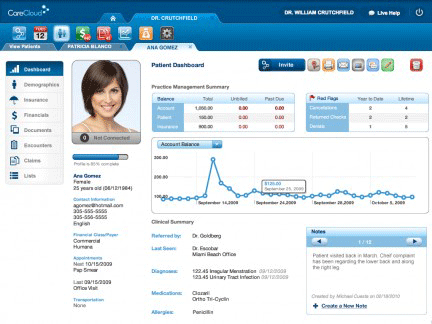
The Patient Dashboard in CareCloud, a modern, cloud-based system
In this guide we discuss the following:
Common Features of Medical Software
Popular Medical Software Comparisons
Common features of medical software
Electronic medical record (EMR) or electronic health record (EHR) software assists in creating and storing digital patient records. Helps track patient notes, demographics, histories and medications. Features include e-prescribing, SOAP notes, E&M coding advice and more. EMRs may also provide medical lab integration, device integration, tablet support and voice recognition. | |
Manages the creation of patient statements and submission of claims. Functions include coding, claim scrubbing, eligibility inquiry, electronic claim submission, payment posting and reporting. | |
Automates the process of scheduling patient visits. Features include automated follow-ups, text message/phone/email reminders and multi-location support. Typically offered with billing in a practice management suite. | |
Manages the operations and workflow of radiology imaging centers. Automates the process of storing, manipulating and distributing patient data and images. | |
Manages the storage and retrieval of DICOM images (X-rays, CAT scans, MRIs etc.). Often used in conjunction with an RIS to execute the radiology workflow efficiently. | |
Automates accounting procedures for healthcare practices. Functions include A/R, A/P, general ledger, financial reporting and more. | |
Combines practice management software and EMR software to handle the business and practitioner sides of a clinic. | |
Helps doctors and practices create, print, record and transmit prescriptions by offering a group of dedicated applications and software add-ons. | |
Allows doctors to stay in communication with their patients by providing educational resources and improving patient-provider relationships. | |
Tracks data for doctors and practices such as patient intake, revenue cycle, reimbursement rates, and other information to help give an understanding of overall operations. |
What type of buyer are you?
Most organizations we speak with are researching and evaluating medical software for one or more of the following reasons:
Transitioning from paper charts to digital records. “It’s raining paper” is the common cry we hear from paper-based practices. These buyers want to cut back on paper, improve office efficiency, reduce errors and run a more effective operation overall.
Replacing outdated software. This is a common scenario we hear from buyers. Their current system—whether it be a homegrown system or from a medical software vendor—is out of date and costly to maintain or update. They want a more modern system that is easier to use, meets federal requirements (e.g., ONC-ATCB certification) or that meets feature/functional needs.
Combining applications into an integrated suite. In many cases these practices have a hodgepodge of disparate applications, and as a result, find themselves doing double data entry and dealing with other inefficient workflows and processes. These organizations invest in integrated medical office management software—that is, integrated EMR, billing and scheduling applications—to centralize all information and functions in one place.
Implementing best-of-breed applications. Conversely, these buyers are focused on applications to address a specific need. Most often, buyers in this category are looking for a stand-alone billing, EMR, RIS or PACS system.
Pursuing federal incentives. Thanks to the HITECH Act of 2009, physicians have been replacing their EHRs or purchasing new ones for the first time to meet federal requirements. In order to qualify for Medicare and Medicaid incentives, physicians—or more accurately, “eligible professionals”—must make “meaningful use” of a certified EHR. The law offered incentives for physicians who complied before 2015, but physicians who still aren’t meeting “meaningful use” standards today face penalties in the form of decreased reimbursements.
We should note that outpatient and inpatient organizations often have different feature/functional requirements. For example, inpatient care provider centers such as hospitals will require systems to support bed management, UB-04 billing and potentially long-term patient stays. Meanwhile, ambulatory care providers such as primary care physicians and specialists will share common feature requirements to support “walk-in/walk-out” care.
Practices looking to integrate business intelligence tools into their existing medical solutions might be interested in healthcare BI software.
Benefits of medical software
The general benefits of any medical system are improved quality of patient care, increased operational efficiency and improved practice profitability. These benefits are created by different applications and impact organizations in different ways.
For example:
The automation of back-office operations streamlines administrative tasks associated with patient encounters, which may enable providers to spend more time with patients and hire fewer staff.
More accurate documentation of these encounters and a more organized claims submission process can lead to improved collections.
Automated alerts prompt providers with potential issues or risks, while automated reminders help patients return to the office when necessary, improving quality of care.
In addition to these general benefits, the major applications found in medical software each provide a host of specific benefits. For example, in 2014 we surveyed physicians about the benefits of electronic health records. They cited “easy access to records,” “more robust/legible records” and “drug interaction alerts” as the top advantages of using an EHR.
Important considerations
Integrated suite vs. best-of-breed. When selecting a system, buyers will have the choice of implementing different applications for specific tasks, or a complete suite of tools to address all their needs. The key decision that most providers will need to make is whether to implement a standalone electronic medical records (EMR) system or replace an existing practice management system with a complete system. We hear from many buyers facing this decision as practice management systems have been ubiquitous since the 1990s and EMRs are increasing in adoption, primarily due to the HITECH Act.
Software-as-a-Service (SaaS). The trend toward cloud computing is impacting many industries, and healthcare is certainly one of them. Web-based, or SaaS, software offers several advantages such as lower upfront costs, reduced IT and support costs, remote accessibility and more. However, practices in rural settings may not have access to the broadband Internet necessary to efficiently run Web-based software. Moreover, Web-based systems may not support all the feature/functional needs of some practices with unique requirements.
Mobile EHR Software. Going hand-in-hand with SaaS, healthcare providers are finding themselves increasingly on the go and accessing systems from multiple offices, home and mobile devices. Tablet (e.g., iPad) and smartphone support, including iPhones and Android phones, is increasingly common. If you will be accessing your software primarily from a mobile device, we suggest choosing a vendor that has developed a native app for your device, such as MediTouch’s iPad EMR.
ONC-ATCB certification. As most healthcare professionals are aware, the HITECH Act of 2009 requires the use of electronic medical records systems by 2015. Eligible professionals can subsequently qualify for up to $44,000 through the Medicare EHR Incentive Program or up to $63,750 through the Medicaid EHR Incentive Program. To qualify, they will need to demonstrate “meaningful use” of one of the ONC-ATCB certified EMRs.
Popular medical software comparisons
Practice Fusion vs NextGen Office